Showing posts with label Daru Island. Show all posts

Tuesday, 27 February 2018

Improving Things at Daru Island

If there is one thing a reluctant flyer is not so excited about going through is to arrive at the destination in the blanket of a passionate night. But a true traveller is unfazed by such a miniscule inconvenience, and the inherent confusion bought about by the darkened unfamiliar place is a welcome challenge.

I arrived at Daru a couple of hours earlier before the sun set down to the East. Interestingly, there are only few cars traveling down the road at any given time. So mostly, it is silent. You can actually hear the neighbours casually chatting to each other if you stay put and say nothing.

Now, isn’t that an ideal place to live in?
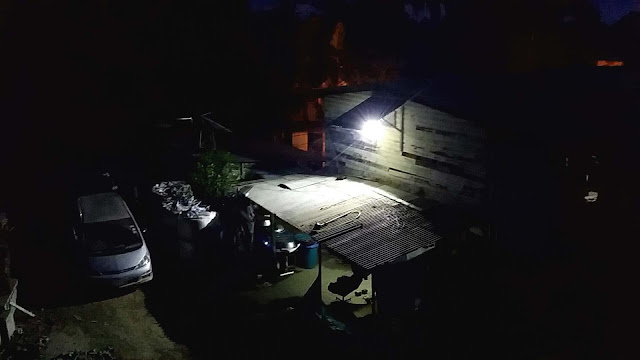

This is the house where the managers live in the company that I work with. In the Philippines, we used to have this joke about a house that may look like it’s ready to go any moment: “Isang anay na lang ang ‘di pumipirma, magigiba na ‘yan.”

So in this case, the house looks like it’s about to go down and is just patiently waiting for that single termite to sign it off.


That night, we ate in this old but surprisingly sturdy house. The managers took turns cooking and that was the whole setup. It was this guy’s turn to cook at that time and they said he cooked a sea worm. 

I don’t know anything about a sea worm, but it does taste good.


The next night, it was Levi’s turn to cook. He whipped out some tin fish with chopped veggies for us. Although I’m all set for cooking, I’m not so familiar yet with all kinds of manner of things in this kitchen. I was told  to just watch and do nothing. Well, that seems to be an easy thing to do except that I still did something and took this photo.


While Levi is preoccupied with his tin fish recipe, another manager shoved a real fish into a hot and steamy pot. This in turn makes me wonder, why bother with tin fish when there are plenty of fish around to catch in Daru Island? 

I guess the answer is that, a tin fish recipe is not a tin fish recipe without the canned fish.


The next day, everyone was up early. I climbed up the new building and had a look at the old accommodation where I had my dinner for two nights. The contractor had informed us the day before that they would begin dismantling this house while everyone was out working. 


By the time the noon came, the house looked like this. That was strange, I thought. Because I saw only two men there.  Unless one is the Flash, and the other is Quicksilver, someone without an intermediate skill in carpentry would have wondered profoundly how these two gentlemen have pulled that off. And while it's an obvious work of human origin, my child-like imagination was suggesting a slightly different theory, thinking that it's a bizarre case of tornado attack right up the alley. If that was really the case, I have got to see that for myself.


My inquisitive instinct has got the better of me and I came back later that afternoon only to feel a little frustrated that my theory about a rogue tornado was not proven true at all. It turns out that life, indeed, has full of surprises. Who said that four men could not demolish an entire building in only a few hours?

I think no one has said that before.


When I look at this photo, all I can think about was the Doozers from The Muppet Show. The Doozers are the tiny characters in Fraggle Rock that love to work and build structures. We used to watch that show when I was younger.  I would always wonder why the bigger puppets in that show love to bite on and destroy the things that the tinier Doozers built.


The Doozers.


After a couple of days, what’s left of it are just the posts and metal beams. This helped me conclude that humans not only evolved to effectively build things but had also become efficient in destroying things.


And while some primates, like Chimpanzees, are known to use tools like sticks to hunt ants for food, only humans are endowed with brains that can think of using complex machines to help bring down things when our primitive hands have met their limits. 


This was the room where I stayed in Daru. It didn’t have much things in between, but the bed was enough for a tired IT Manager.  Anyway, I was hoping to finish my work assignment in a month or so. There were lots of things to be done and I could always use a good night sleep.

Until next time.


Thursday, 7 December 2017

Divine Providence

Up until now since God has created everything including us, humankind, all of existing evidences that are circumstantial in nature are by far leading up to one point that seem to suggest that His intervention is a continuous event even in the aftermath of the creation.

If you think about it, it’s very hard not to cogitate a notion that someone out there is keeping the whole universe in natural order. Someone who has the capacity to provide us with a billion-year assurance that everything we need to remain in existence in our lifetime like sunlight, rain and food for example are being equally provided to us all no matter how good or bad we may have behaved in the last Christmas.


In Koki Fish Market, one can learn from looking at the fishes being sold there about how impressive God’s entities can be. If you observe them closely, you may probably notice that all fishes are like diversities of cloned creatures. While majorities of the fish in the market are moderate in sizes, some are really enormous and may require several people to reel out of the water. Yet they all share a common trait that makes them a mouth-watering delicacy, and that is the idea that aside from being a healthy treat, they are yummy.

But one can be forgiven for oversimplifying that fishes are just foods in general; perhaps it is due to how widely they are viewed as part of most culinary practices.


In Papua New Guinea, it’s a common thing to see Tunas of various fin colours being ended as goods in fish markets. Tuna is my favourite fish to buy because of how it looks. They always have a solid appearance that make them look good when grilled over.

I’ve been meaning to grill one but I haven’t got around to that yet.


If you can imagine a world without fish, do you think that we could substitute rats for the fish? My mental picture-processing unit is refusing to visualize a dead rat being grilled at the moment. Luckily, we haven’t arrived to that point yet. Fishes have an astonishing reproductive strategy in that some of them lay eggs in thousands, which externally fertilise leaving more room for the parents to party around without giving much attention to the surviving hatchlings.  

I don’t think we can out-eat their ability to reproduce yet.


Speaking of party, our parties in Papua New Guinea are held mostly in the house and may involve a round of a few drinks. 


How much does a typical bundle of fish cost in Port Moresby? At the time of this writing, it’s about K20 to K30 a bundle and that still depends on the kind of fish. 


A typical strategy that one can use for rating out a fish’s freshness is by scrutinizing the fishes’ gills. Fresh fishes have red gills and don’t have a red and cloudy eyes.  Our friend Jay-ar here is gingerly inspecting a bundle of fish for any sign of being stale. 


The seas of Papua New Guinea account for the major source of the fishes sold in the market, the other sources include tropical rivers and man-made lakes. In the open seas, there is always a bigger fish capable of eating other smaller fishes. It’s an uncomfortable truth but that’s how life is going on in the seas.


In one occasion, we have chanced upon a group of either Japanese or Korean nationals doing a documentary of something. There’s our friend Ryan on the left trying to have a conversation with one of the camera person on the right.

That begs a question; did Ryan initially say Ohayo gozaimasu or Anneyonghaseyo? I’ll have to ask him about it.


I’m not a fan of octopus but at one point in time, I bought one or two just to try it out.


My culinary skills haven’t evolved to chef level yet and I don’t know if it will ever be, but I have a never-ending fascination to learn from observing other people's work. These octopi are rather getting a good boiling from Raffy. Raffy is another IT manager in the company that I’m working with and one of the things that we have in common is an unwavering interest in cooking.


These green-looking bags are an interesting sight to see in Koki and are usually placed at the entrance of the market. They contain big clams in them and are sold for K10 to K15 each bag at the time of this writing.


If you like to try and increase the amount of iodine in your body naturally, try cooking out these clams.  It’s a known source of iron and iodine, which is good for our thyroid health. Every once in a while, it is available at Koki Fish Market. Clams are known to ingest dirt in them so it is best to have them submerged in the water first for a whole day.


Crabs are also found in both Port Moresby and in Daru Island but the latter has more of it. These decapod crusaceans in Papua New Guinea are capable of reaching to the size of a regular table plate. They can grow that much that even four people can share a piece among themselves.  I took this in Daru Island when I went there sometime around September this year.


Here’s me way back in 2011 with a really big crab that was sent to me by my cousin Marlon from Daru Island. Three of us had shared this crab on that day. You can see that the pincers are almost as big as my hands.


And here are the crabs that I brought from Daru last September, 2017. I gave them away to my co-managers as pasalubong. I don’t fully understand the whole meaning of that word but it probably has something to do with an old phrase, “Share your blessings.”


Tropical fishes raised in captivity for commercial purposes are also abundant in Papua New Guinea. Here’s me frying Tilapia with my hand fully enclosed in a custom-built boiling oil deflector shield.

You see, no matter how difficult life gets, there is always a clear indication that God’s grace is working in silence. All that one needs to do is act on it. The fishes are all swimming freely somewhere out there and one just needs to try and catch them.

Happy weekend everyone!


Saturday, 2 September 2017

Daru Island, My Arrival

One of the few things that I thought would not come to pass was the possibility of going to Daru Island. For starters, I always have the notion that life in Daru is particularly hard, having heard about the grievances in shortage of water supply or the intermittent power loss or the lack of mobile signal therein. Hence, I came up with a foregone conclusion that nothing on Earth could make me go to Daru.

 Well, almost.

On Monday, 7th of August, I booked for a flight to Daru via Air Nuigini. The company that I am currently working with has a branch in Daru Island that is being renovated and I was sent there to help. My directives were to install network cables, CCTV cameras and its public address sound system. Aside from those, I am also tasked to assist Harsya, an Indonesian national, and to make sure that the new POS Systems that our company has acquired from him should be up and running before the grand opening on the 21st of August.

The purple luggage is mine and is packed with a week’s supply of fresh clothing.


I had successfully checked in my baggage two hours earlier before the flight. I figured that if I had to endure the long wait before boarding time, I needed to, at least, eat something to keep my mouth busy during the whole waiting process. Luckily, there’s a small cafeteria near the boarding gates, which has an adequate variety of pastries to choose from. 


When embarking on a long journey, I made it a habit not to indulge myself in a heavy meal. Therefore, my ideal choice of food in the cafeteria at the time being has involved a combo of fruit slices and a chicken sandwich. On the left side is my boarding pass. The typical air fare to Daru from POM is around K500 to K700. I’m not sure though what kind of variable is at play here for the price shift but the frequent flyers might figure that out easily.


Turboprop planes are the main mode of air transportation to Daru.  During take offs, the plane may bank sideways to adjust directions. This can cause the plane to appear like it’s stalling. But one must not fear that moment because turboprop planes are highly efficient while flying slow and are less efficient when flying fast.

I always like to think that airplanes are safe.


Unlike jet planes, turboprop planes show little or no visible exhaust gases that produce the trust, and instead direct all of its exhaust gases to turn the propeller. The land mass below was of Port Moresby. Shortly after taking this view, the pilot has announced that we are in for a long flight. An hour and fifteen minutes later, we were on Daru Island.


For such a short flight, I wouldn’t expect the crew to be serving us any meals. But they did serve us with these nice treats. I finished them all in five minutes. The flight attendant seemed delighted.


Daru Airport was relatively small compared to Jackson Aiport at POM. But again, turboprop planes can operate on short runways.  And if the pilots were to try, they could land the plane on someone’s front lawn without a problem.

Just kidding.


The huge door in the building is the departure area and on the left side is the arrival area. The building doesn’t have a conveyor belt that brings your luggage to you as you wait but rather relies on the human workforce to stockpile your belongings on a large table where it is good enough for everyone to see.


When I arrived at the airport, this fellow was already patiently waiting for me. By the way, kuya Levi is in Daru at the time being and Sarigi (this guy) said that it was kuya Levi who arranged for him to pick me up at the airport. Thanks for the effort Sarigi.

Good job kuya Levi. Cheers!


They say that Daru Island is quite a small place. It only has a population of more than 13,000 probably. Wikipedia says it actually has an area of 14.7 km2, and it’s quite big for an island. You could fit in it around 1,400 soccer fields. 

Now that’s a lot of soccer fields!


This is the view from our branch in Daru. We are located on the beach side. The boats in the background seemed to have been stuck on the muddy shore, but it was actually low tide when I took this photo. Later that night, all of those boats are floating on the water.

Well, it turned out that life in Daru wasn't as hard as what I thought it was. Telikom PNG is operating in the Island so there is a telephone line except for its mobile services. Telikom ADSL internet is available through landline connection which suits those who'd like to stay longer. Digicel internet is available through mobile 3G and it's quite fast for the average internet users although most of the time the network is down.

Water supply comes from the rainwater collected into reservoirs which you can safely use for cooking and bathing. There are also deep wells that serve as a backup system in case there's hardly a rain. I didn't a have problem with water supply since the day I arrived. For drinking, it's most likely that you're offered to drink bottled water instead.

Electricity is also consistent, thus far. During my stay, I only experienced two power outage at least.

That’s all for today. Have a good Sunday everyone! :)


Related Posts Plugin for WordPress, Blogger...